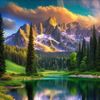
@wilderness_ai: What if Monument Valley woke up one October morning—and the desert was gone? Not its mountains. Not its ancient sandstone towers. Not the vast horizon that makes everything beneath it feel small. Only the desert. In its place, an endless sea of autumn. Imagine standing on a high red-rock overlook beneath a sky the color of rain. Clouds move slowly over the valley, softening the light. In the distance, familiar buttes rise like colossal stone islands—unchanged, unmistakable, impossibly beautiful. But below them, the earth has transformed. Where dusty plains once stretched toward the horizon, forests now burn with the colors of a New England October: scarlet maple, molten amber, copper, russet, and gold. Millions of trees roll across the basin like a living tide, wrapping around the bases of sandstone monuments that once stood alone. Between the forests lie lakes. Not bright turquoise. Not sparkling blue. Black. So still and dark they seem to hold a second world beneath their surfaces. A towering butte appears twice: once against the storm clouds and once, perfectly inverted, in the water. Gold leaves gather along the shoreline. A ribbon of mist threads between the trees, then disappears against a rust-red cliff. There is almost no wind. Every reflection stays intact. Walk farther and the scene changes again. Narrow peninsulas of autumn woodland push into the water. Rocky islands wear crowns of red and orange. Beyond them, sandstone spires climb through the canopy, their sun-warmed faces glowing beneath the heavy gray sky. Nothing feels pasted together. The forest follows the folds of the land. The lakes occupy the low basins. The cliffs still command the horizon. Even the clouds seem to belong to this impossible place. And somewhere in that vast silence, you begin to forget which parts are real. Monument Valley is real. Its sandstone buttes and mesas stand in the American Southwest, in a landscape shaped by time, erosion, and the elements. New England’s autumn is real, too—the astonishing transformation of forests into a thousand shades of red and gold. And dark, glassy lakes really can turn a landscape upside down. But this particular valley? It exists only in imagination. We borrowed the geology of one world, the season of another, and the stillness of a third—and let them become something neither place has ever been. This landscape is imagined. But the feeling it awakens is real. 📍 SEARCHABLE WONDER TRAIL • Monument Valley — Arizona–Utah sandstone buttes • Navajo Nation — home of Monument Valley • New England fall foliage — peak autumn color • Red sandstone mesas and desert geology • Autumn forests — red maples, amber and gold • Black mirror lakes — still-water reflections • Overcast landscape photography • Imagined landscapes and fantasy geography • Cinematic nature art • wilderness.ai Library of Wonder 🌎 WHY IT BELONGS IN THE LIBRARY OF WONDER Not every place we explore has to appear on a map. Some are born when real landscapes meet in the imagination. This one honors the beauty of Monument Valley and New England without pretending they share the same climate. WONDER QUESTION If you could give one famous landscape an entirely different season or climate, which place would you transform—and what would it become? SHELF: IMAGINED WILDERNESS An artistic reimagining, not a photograph of a real location. #ImaginedWilderness #MonumentValley #FallFoliage #LandscapeArt #LibraryOfWonder
wilderness_ai
Region: US
Friday 06 November 2026 00:13:44 GMT
Music
Download
Comments
There are no more comments for this video.
To see more videos from user @wilderness_ai, please go to the Tikwm
homepage.


